
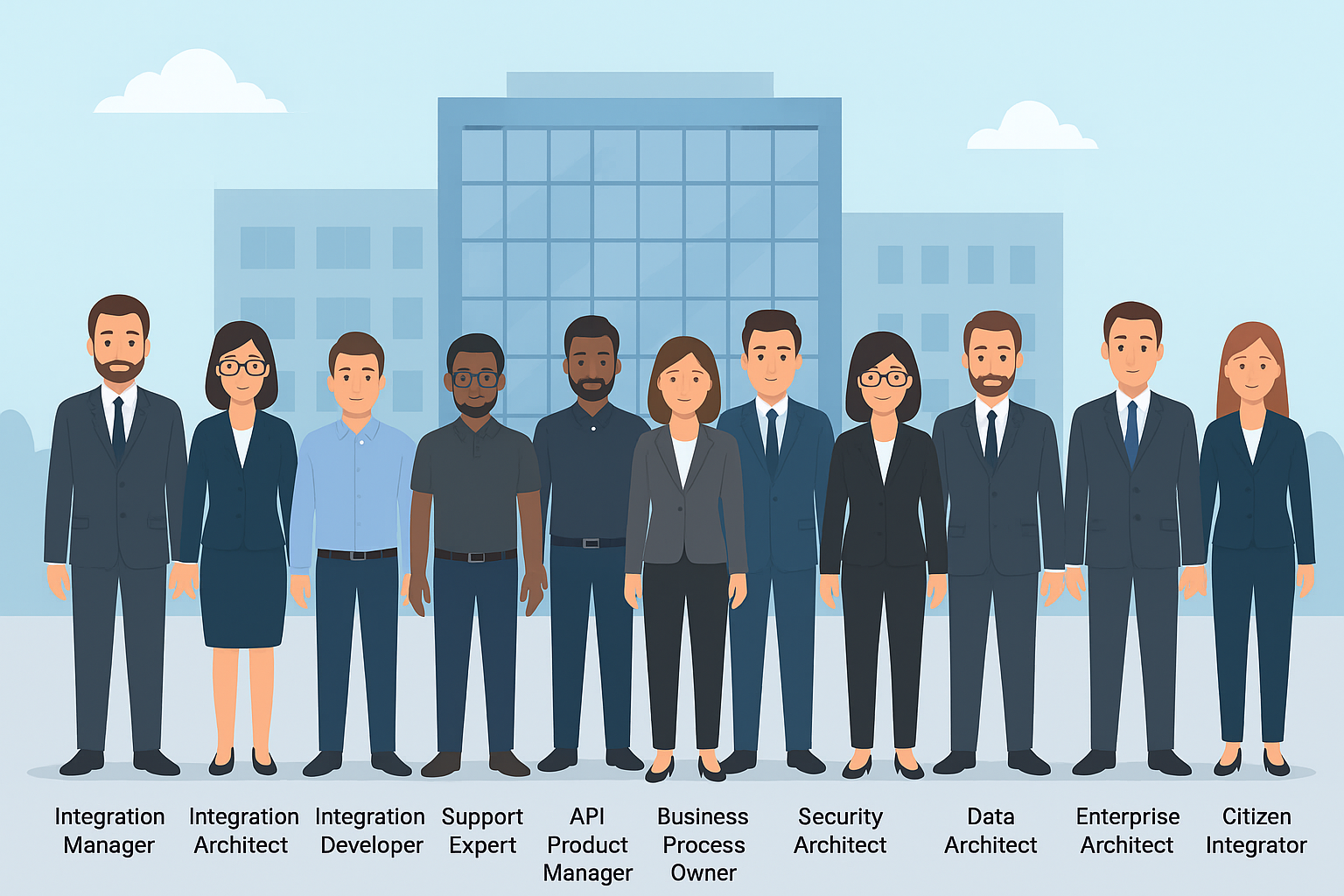
This article is listing and characterizing typical personas working with (enterprise) integration and interfaces. We are focusing here on IT personas only, although some can be also located in business departments.
To be considered: This is a Top-10-Listing (focusing on the most commonly existing personas), however not all of them exist in every organization and sometimes one human is covering the work of several personas.
- Integration Manager / Team Lead / Platform Owner
- Integration Architect
- Integration Developer / Expert
- Support Expert (AMS / Operations)
- API Product Manager / API Owner
- Business Process Owner/Expert / Application Owner
- Security Architect
- Data Architect / Data Engineer
- Enterprise Architect
- IT Project Manager
[1] Integration Manager / Team Lead / Platform Owner
- Focus: Integration Strategy, Governance, Portfolio, IPaaS Stability & Roadmap
- The Integration Manager is the owner of the integration discipline in the enterprise and requires a holistic view of integration landscapes, platform usage, standards compliance, team performance, and KPIs to ensure efficient and governed integration delivery.
- Sometimes organizations (depending on their size/complexity/maturity) have even multiple roles here. In fact we also can have multiple team leads and platform owners (by integration component: SAP Integration, MuleSoft, Kafka).
- A platform owner is responsible for the platform lifecycle (updates, capacity, licenses, roadmap) and ensures the platform is stable, secure, and adopted correctly.
[2] Integration Architect
- Focus: End-to-end integration design
- The integration architect owns the solution design for cross-system integration and defines/selects patterns and technologies (APIs, events, EDI, ETL, iPaaS, ESB) by ensuring security, resilience, reliability. The definition of canonical data models and contract versions can be in scope as well.
- The key needs of an integration architect are runtime and design-time transparency, governance and documentation as well as the detection of technical debt.
- In some organizations the enforcement of governance like standards and the definition of guardrails is managed by the architect (delegated by the manager / team lead).
[3] Integration Developer / Expert
- Focus: Implementation and technical delivery
- The integration developer is responsible for the build of interfaces (APIs, mappings, message flows, transformations) by ensuring error handling, logging, monitoring and deploying/testing integration flows.
- The key needs are good tooling (debugging, deployment, CI/CD), test data and traceability, and clear design documentation
[4] Support Expert (AMS / Operations)
- Focus: Stability of integration runtimes
- Responsible for the monitoring of message flows, queues, connectors, APIs
- Resolving incidents, ensuring SLAs and availability
- Key Needs: Centralized monitoring & alerting, automated issue detection (e.g., failures, delays, backlog)
[5] API Product Manager / API Owner
- Focus: API lifecycle & consumers
- Responsible for the definition of API products and roadmaps by managing API specs, versioning, SLAs as well as alignment with consumer requirements
- Key Needs: Usage analytics and consumption metrics, managing the developer portal, catalog, documentation, governance and discoverability
[6] Business Process Owner/Expert / Application Owner
- Focus: Business-level integration outcomes
- Responsible for the definition of process requirements, making sure integration supports business flows (order-to-cash, hire-to-retire) and collaboration with integration teams on requirements
- Key Needs: Transparent view of critical interfaces, business KPIs (e.g., order throughput, message success rates), clear communication during incidents
- A specific persona from a business-oriented/functional perspective is the Citizen Integrator who is empowered to create self-service integrations. This works for no-code platforms like Microsoft Power Automate or by configuring (predefined) standard integration content of SAP Cloud Integration (as part of SAP Integration Suite).
[7] Security Architect
- Focus: Secure integration
- Responsible for authentication & authorization models (OAuth, mTLS, API keys, etc.), ensuring compliance, data protection, logging, approving integration patterns from a security perspective
- Key Needs: Central view of access, certificates, and endpoints as well as consistent policies across integration channels
[8] Data Architect / Data Engineer
- Focus: Data consistency and flow
- Responsible for the management of data models and data lineage, ensuring data quality in integration contexts, design streaming vs. batch data flows
- Key Needs: Metadata catalogs, event schema governance, end-to-end data traceability
[9] Enterprise Architect
- Focus: Strategy, target architecture, capability maps
- Responsible for the definition of integration principles and standards, governs integration patterns (API-first, event-driven, SOA, etc.), drives simplification and reduce coupling across the landscape, ensures integration supports business capabilities and roadmap
- Key Needs: Holistic visibility into interfaces, compliance to architecture guidelines, impact analysis for changes
[10] IT Project Manager
- Focus: Project delivery and resource coordination
- Responsible for coordinating, tracking, and ensuring that integration projects are delivered successfully, while balancing time, resources, and risk.
- The IT Project Manager needs centralized visibility into integration projects, real-time status and dependency insights, effective collaboration tools, clear governance guidance, and measurable KPIs to ensure timely, on-budget, and compliant delivery of integration initiatives.
| Group | Personas | Focus |
|---|---|---|
| Strategic / Governance | Enterprise Architect, Integration Manager / Team Lead, Platform Owner, Security Architect | Integration strategy, governance, architecture, security, team leadership |
| Design / Delivery | Integration Architect, Integration Developer / Expert, API Product Manager / API Owner, Data Architect / Data Engineer | Solution design, implementation, API lifecycle, data flows |
| Operations / Support | Support Expert (AMS / Operations) | Monitoring, incident handling, SLA management |
| Business / Functional | Business Process Owner / Application Owner, Citizen Integrator | Business process requirements, self-service integration |
| Project Management | IT Project Manager | Project delivery and resource coordination |
